




Table of Contents
Table of Contents
A China shipping quote can look pleasantly cheap at first. Then the final invoice arrives with a fuel adjustment, an extended-area fee, and a peak-season charge. Suddenly, the “cheap” parcel is not so cheap.
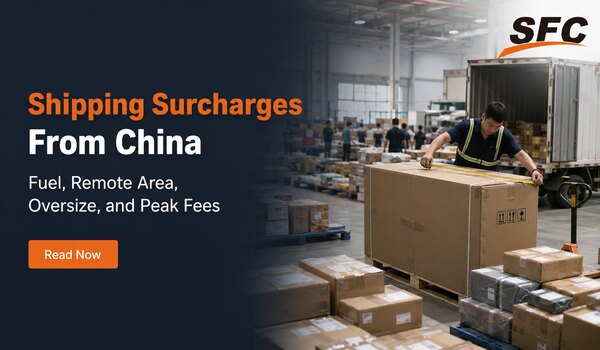





That does not always mean the carrier made a mistake. Often, the base rate covered a normal shipment. Your package, route, timing, or delivery address created conditions outside that normal assumption.
This is why sellers need to look beyond the headline rate. The real question is not, “What is the cheapest shipping price?” It is:
What will this shipment cost after the carrier, warehouse, route, package, and delivery conditions are all included?
This guide explains the most common shipping surcharges from China, including fuel, remote area, residential, oversize, additional handling, peak, customs-related, and exception fees. It also shows how ecommerce brands can predict them, reduce avoidable charges, and compare shipping quotes more fairly.
We will use a simple framework throughout:
- Condition: What shipment condition triggers the fee?
- Charge: How might the fee appear on a quote or invoice?
- Control: What can the seller do before dispatch or in the contract?
What Is a Shipping Surcharge?
A shipping surcharge is an additional charge added to a base transportation rate because a shipment creates extra cost, handling, distance, risk, or capacity pressure.
The phrase is often used loosely. A carrier may call it an accessorial charge. A 3PL may call it a pass-through fee. A warehouse may charge a separate handling fee for work that happens before carrier handoff.
These are not always the same thing.
The Main Fee Types
|
Fee Type
|
What It Usually Covers
|
Example
|
|
Base freight rate
|
Normal transportation from origin to destination
|
Standard parcel movement
|
|
Carrier surcharge
|
An extra carrier cost caused by fuel, size, location, demand, or handling
|
Fuel or remote-area surcharge
|
|
3PL pass-through charge
|
A carrier or third-party charge passed to the seller by the fulfillment provider
|
Carrier oversize fee plus agreed markup
|
|
Warehouse service fee
|
Work performed by the warehouse or 3PL
|
Relabeling, repacking, inspection, or special handling
|
|
Customs or brokerage fee
|
Clearance, documentation, disbursement, or inspection work
|
Brokerage charge on an express shipment
|
|
Duty and tax
|
Government charges connected to importation
|
Import duty or VAT
|
|
Customer-facing shipping fee
|
Amount charged to the buyer at checkout
|
Flat-rate or calculated shipping
|
The distinction matters because the solution changes. Better packaging may reduce an oversize carrier charge. It will not remove an import tax. Better address data may prevent a correction fee. It will not change a published fuel adjustment.
A Simple All-In Shipping Formula
Use this practical model when comparing shipping options:
All-in shipping cost = base transportation rate + carrier surcharges + origin handling + destination handling + customs or brokerage charges where applicable + 3PL fees + expected exception cost
“Expected exception cost” means the average cost of things such as delivery failures, returns, reships, damage, and customer support. It does not need to be perfect. It just needs to stop your spreadsheet from pretending that every parcel arrives perfectly.
If you are building the wider fulfillment-cost model, this guide to China fulfillment cost components can help separate storage, receiving, pick-and-pack, shipping, and account fees.
The Main Shipping Surcharges From China at a Glance
|
Surcharge
|
Typical Trigger
|
Where It May Appear
|
Seller Control
|
|
Fuel surcharge
|
Carrier fuel costs or a published fuel index
|
Carrier invoice or rate sheet
|
Partial; compare indexes and negotiate terms
|
|
Remote-area surcharge
|
Rural, island, mountain, or extended postcode
|
Shipping label or post-billing adjustment
|
Often; validate address and route
|
|
Residential surcharge
|
Delivery to a home rather than a business location
|
Parcel invoice
|
Partial; route by service and address type
|
|
Oversize surcharge
|
Length, girth, volume, or weight exceeds a threshold
|
Carrier invoice
|
Strong; right-size packaging
|
|
Additional handling
|
Irregular, fragile, unstable, or non-conveyable parcel
|
Carrier or 3PL invoice
|
Strong; improve packaging and labeling
|
|
Peak surcharge
|
Seasonal demand or network capacity pressure
|
Rate table or invoice
|
Partial; plan inventory and capacity
|
|
Demand or congestion fee
|
Temporary network, port, or capacity pressure
|
Freight or carrier invoice
|
Partial; adjust timing and route
|
|
Address correction
|
Incorrect, incomplete, or changed address
|
Carrier invoice
|
Strong; validate before label creation
|
|
Re-delivery or return fee
|
Failed delivery, refused parcel, or return to sender
|
Carrier and warehouse invoice
|
Strong; improve data and communication
|
|
Customs or brokerage fee
|
Clearance, inspection, or disbursement work
|
Carrier, broker, or 3PL invoice
|
Partial; improve documents and product data
|
Not every shipment can trigger every fee. A small parcel going to a standard business address in a normal period may have very few extras. A large residential parcel to an island during a capacity crunch is a different animal.
Fuel Surcharges: Why the Base Rate Moves With Energy Costs
Fuel is one of the most familiar extra fees. It is also one of the easiest to misunderstand.
How Fuel Surcharges Work
Carriers may calculate fuel adjustments using a published index, a carrier fuel table, a periodic percentage, or contract-specific language. The update schedule can be weekly, monthly, or tied to another defined period. The calculation base can also differ.
For example, one agreement may apply the adjustment to the transportation charge only. Another may include selected transportation-related services. A freight contract may use bunker adjustment language rather than the parcel terminology used by an express carrier.
Do not compare “fuel surcharge: 12%” from one quote with “fuel surcharge: 12%” from another until you know the base, effective date, currency, service, and exclusions.
Official carrier pages are the safest place to verify a current fuel table. For example, UPS publishes fuel surcharge information and effective-date details. Carrier rules can change, so an old screenshot or a rate copied from a forum is not enough.
Why Fuel Charges Are Hard to Compare
Check these points:
- Which fuel index is used?
- When does the adjustment update?
- Is the rate different for air, ground, ocean, or postal services?
- Is the adjustment applied to line haul, pickup, or other services?
- Are minimum fees or rounding rules involved?
- Does the quote show the current rate or a future estimate?
- Is the fuel fee already included in the headline price?
The last question causes plenty of confusion. One provider may show an all-in shipping rate. Another may show a low base rate and list fuel separately. The second quote can look better until the two are placed side by side.
How to Control Fuel Exposure
Fuel is not always avoidable, but the uncertainty can be reduced.
- Compare all-in rates rather than base rates alone.
- Consolidate suitable parcels or supplier shipments.
- Avoid emergency transport caused by poor inventory planning.
- Ask for the fuel index, update schedule, and calculation base.
- Request a cap, floor, or notice period when shipment volume supports negotiation.
- Model several fuel scenarios in the margin calculation.
Treat fuel as a variable. It is not a permanent fixed percentage just because this month’s invoice looks stable.
Remote Area and Extended-Area Surcharges
Remote-area fees are linked to the destination, not the distance shown on a map alone.
What Counts as a Remote Destination?
Depending on the carrier and service, the destination may be classified as remote, extended, outlying, rural, or difficult to serve because of:
- low shipment density;
- islands and offshore locations;
- mountain or desert routes;
- distant rural postcodes;
- special ferry or feeder transport;
- limited delivery days;
- additional local handoff requirements;
- territories outside the carrier’s standard network.
A postcode can be standard for one carrier and remote for another. A courier may have a local partner that makes the route normal, while an express service applies an extended-area fee.
Why a Remote Fee Appears After the Quote
The initial price may be based on a country and city only. The carrier applies the postcode rule later, when a complete address is entered or the label is created.
Other possibilities include:
- the provider used an outdated remote-area list;
- the order was routed through a different last-mile network;
- the address required an additional delivery attempt;
- the quote excluded destination accessorial charges;
- the customer entered an incomplete or unusual address.
This is why “shipping to Canada” or “shipping to Australia” is not enough detail for a reliable estimate. The postcode and service matter.
How to Reduce Remote-Area Cost
- Validate the postcode before promising a shipping price.
- Keep a current serviceability list for your main carriers.
- Compare postal, courier, pickup-point, and local delivery options.
- State remote-area exclusions in customer-facing shipping rules.
- Use destination-country inventory when remote demand is stable and concentrated enough to justify it.
- Add a remote-area reserve to the margin model instead of hoping the fee never appears.
For brands shipping from China, a consolidated shipping solution can help compare route options before multiple supplier shipments are sent separately. Consolidation does not magically remove the destination fee, but it can reduce unnecessary origin handling and improve route planning.
Oversize, Large-Parcel, and Additional-Handling Fees
Oversize charges are where packaging decisions become shipping decisions.
Actual Weight Versus Dimensional Weight
Actual weight is what the package weighs on a scale. Dimensional, volumetric, or dimensional weight converts package volume into a billable weight. The carrier may charge using whichever applicable figure is higher.
The exact divisor and rounding rules depend on the carrier, service, origin, destination, and contract. FedEx explains that dimensional weight is based on package volume and that the applicable billable weight can depend on the service rules. See its official dimensional weight and shipping surcharge guidance before using a formula in a quote.
An illustrative formula may look like this:
Dimensional weight = length × width × height ÷ carrier divisor
Suppose a light product is packed in a 40 × 30 × 20 cm carton. The volume is 24,000 cubic centimeters. Using an illustrative divisor of 5,000, the dimensional weight is 4.8 kg. A smaller protected carton measuring 30 × 22 × 14 cm produces an illustrative dimensional weight of about 1.85 kg.
These are examples, not a promised carrier saving. Actual billing depends on the relevant rate sheet, measurement method, rounding, and minimums.
Common Oversize and Additional-Handling Triggers
Fees can be triggered by:
- maximum length;
- length plus girth;
- total volume;
- actual weight;
- irregular or cylindrical shapes;
- non-conveyable parcels;
- unstable or poorly wrapped pallets;
- exposed edges or loose straps;
- packages that require manual sorting;
- products that need special protection or labels.
Sometimes the box is not technically “oversize,” but it still attracts additional handling because it cannot move safely through the normal conveyor or sorting process.
Packaging Materials and Oversize Prevention
Use packaging to control both cost and damage:
- corrugated cartons for stackable products;
- poly mailers for suitable soft goods;
- padded mailers for products that need light impact protection;
- inserts and void fill to stop movement;
- pallets and stretch wrap for stable freight units;
- clear labels placed where scanners can read them;
- export-ready packaging that does not need another repack at origin.
The aim is not to use the thinnest carton. It is to use the smallest practical package that survives the route.
SendFromChina’s packing service can be relevant when a brand needs packaging, repacking, or package-standard work at origin. The fit depends on product type, volume, and the required delivery service.
A Simple Oversize-Control Test
Take your ten highest-volume SKUs and record:
- product dimensions;
- current package dimensions;
- actual weight;
- billed weight;
- packing time;
- damage and return rate;
- any additional-handling or oversize fee.
Then test a smaller package on products that can tolerate it. Measure the complete result. A package that saves 20% in volume but doubles packing time is not automatically a winner.
Peak, Demand, and Capacity Surcharges
Peak fees are not limited to one holiday week. They can appear when demand, labor, weather, promotions, or network constraints push a carrier beyond normal capacity.
Peak Season Is a Capacity Problem
Common pressure points include:
- major shopping events;
- holiday parcel volume;
- product launches and crowdfunding campaigns;
- weather disruption;
- factory shutdown planning;
- limited flights or vessel space;
- labor shortages;
- port, airport, or line-haul congestion.
A carrier may publish a peak surcharge for a defined period. It may also introduce an emergency or demand-related adjustment when conditions change. Those are different commercial events and should not be treated as one permanent fee.
How to Plan for Peak Charges
- Forecast units, parcels, dimensions, destinations, and service mix—not units alone.
- Secure capacity early for products with hard customer promises.
- Pre-build bundles and packaging materials.
- Ship replenishment stock before the busiest window when storage economics support it.
- Set clear order cutoffs and communicate realistic delivery dates.
- Compare the cost of a premium service with the cost of late delivery, refund requests, and lost repeat orders.
- Confirm the peak-fee effective dates and exceptions in writing.
|
Fee Situation
|
Typical Trigger
|
Planning Window
|
Preventability
|
Useful KPI
|
|
Published peak surcharge
|
Carrier-defined busy period
|
Several weeks or months
|
Partial
|
Cost per shipped parcel
|
|
Demand surcharge
|
Sudden volume or network pressure
|
Shorter and less predictable
|
Partial
|
On-time delivery by service
|
|
Congestion-related charge
|
Port, airport, or line-haul delay
|
Route dependent
|
Partial
|
Transit-time variance
|
|
Emergency capacity charge
|
Limited space or disrupted route
|
Immediate
|
Low to partial
|
Successful delivery rate
|
The key is not to eliminate every peak fee. Some capacity costs are real. The key is to prevent the fee from arriving alongside poor forecasting and missed customer promises.
Other Surcharges Sellers Commonly Miss
Residential Delivery Fees
A delivery to a home may cost more than a delivery to a commercial address because the route, stop density, access, or handling model is different. DTC brands have a high residential mix, so this fee should be included in the normal customer-order model rather than treated as a rare exception.
Check how the carrier classifies apartments, home offices, rural businesses, and pickup points. Do not assume the customer’s wording determines the carrier’s classification.
Address Correction and Invalid Address Fees
Small data errors can create large operational problems. Examples include:
- missing apartment or unit numbers;
- wrong postal codes;
- city and postcode mismatch;
- incomplete phone information;
- transliteration differences;
- abbreviations that confuse the local delivery system.
Validate addresses before label creation. For cross-border shipments, keep the recipient name, phone, postal code, and local address format consistent with the destination’s requirements.
Re-Delivery, Return-to-Sender, and Failed-Attempt Charges
A failed delivery may produce more than one charge. The carrier may charge for another attempt. The warehouse may charge to receive and inspect the returned parcel. A replacement shipment may create a second shipping cost.
Track first-attempt delivery rate and return-to-sender rate by destination. If one postcode group keeps failing, the solution may be a different service or clearer customer communication—not a blanket carrier switch.
Customs, Brokerage, Disbursement, and Inspection Charges
These fees are related to cross-border clearance, but they are not automatically the same as a shipping surcharge.
- Duty and tax are government charges.
- Brokerage covers customs-entry work.
- Disbursement may cover a provider advancing money or managing payment.
- Inspection may create extra examination or handling work.
- Clearance service fees may be charged by a carrier, broker, or 3PL.
Use an HS code and tariff-rate check to investigate product classification and tariff questions, but confirm the final treatment with the relevant customs authority or broker. A tariff tool does not replace shipment-specific compliance advice.
Special Handling and Restricted-Item Fees
Batteries, liquids, magnets, fragile products, branded goods, cosmetics, and unusual shapes may require special packaging, documentation, routes, or carrier approval.
The charge may appear as a dangerous-goods fee, manual processing fee, screening fee, or special handling fee. It may also appear as a delay if the shipment cannot enter the normal network.
List product attributes accurately at the quoting stage. Hiding a restricted characteristic rarely produces a useful long-term rate.
Can Multiple Surcharges Apply to One Shipment?
Yes, depending on the carrier, service, route, contract, destination, and timing.
Here is a clearly illustrative example for a parcel from China:
|
Charge
|
Illustrative Amount
|
Possible Trigger
|
Controllability
|
|
Base transportation
|
$18.00
|
Standard route and service
|
Compare providers
|
|
Fuel adjustment
|
$2.16
|
Published adjustment applied to base transport
|
Partial
|
|
Residential delivery
|
$3.50
|
Home delivery classification
|
Partial
|
|
Remote-area fee
|
$7.00
|
Destination postcode on carrier list
|
Partial
|
|
Peak fee
|
$2.50
|
Effective date during a busy period
|
Partial
|
|
Address correction
|
$5.00
|
Missing or incorrect address detail
|
Strong
|
|
Illustrative total
|
$38.16
|
Several conditions stack
|
Audit each trigger
|
The numbers above are not market benchmarks or a SendFromChina quote. They simply show how a base rate can become a much larger all-in charge. Some contracts bundle or exclude certain fees. Always check the applicable rate sheet.
How to Audit a China Shipping Invoice
An invoice audit does not need to be a dramatic confrontation. Start with a sample of recent shipments and look for repeatable patterns.
Step 1: Match the Invoice to the Shipment Record
Check tracking number, service, ship date, origin, destination, weight, dimensions, delivery term, and package type. If the invoice lacks enough evidence, request it.
Step 2: Recalculate Billable Weight
Compare actual weight, measured dimensions, dimensional divisor, rounding, and the rate sheet that applied on the ship date. A reweigh can be correct, but it should be explainable.
Step 3: Verify the Trigger
Check the remote postcode list, peak effective date, fuel table, oversize threshold, address-correction note, and exception code. Do not approve an extra fee just because the description sounds familiar.
Step 4: Separate Pass-Through Fees From Markup
Ask whether the charge comes from the carrier, warehouse, customs broker, or 3PL. Then check currency conversion, minimums, and agreed margin. “Carrier surcharge” and “our handling fee” should not be hidden in one vague line.
Step 5: Compare the All-In Result
Compare total cost per successfully delivered order. Include late deliveries, damage, returns, reships, and customer-support work where the data is available.
|
Audit Check
|
Evidence Needed
|
Question
|
|
Fuel
|
Effective table and calculation base
|
Was the right index and date used?
|
|
Remote area
|
Postcode list and destination
|
Was the fee valid for this service?
|
|
Oversize
|
Measured dimensions and weight
|
Was billable weight calculated correctly?
|
|
Peak
|
Published effective period
|
Did the shipment fall inside the period?
|
|
Address correction
|
Original and corrected address
|
Was the error preventable?
|
|
Customs or brokerage
|
Entry, broker, and payment records
|
Is this a shipping surcharge or a clearance fee?
|
|
3PL handling
|
Work order and contract definition
|
Was the extra warehouse work authorized?
|
How to Reduce Avoidable Shipping Surcharges
Most controllable fees come down to five operating improvements.
1. Improve Shipment Data
Keep accurate weights, dimensions, product attributes, addresses, postcodes, phone details, customs descriptions, and declared values. Bad data makes the quote fragile.
2. Improve Packaging
Right-size cartons, standardize package families, stabilize pallets, reduce empty space, and protect the product without adding unnecessary volume. Review packaging after a product or bundle changes.
3. Improve Consolidation
Combine suitable supplier shipments and plan customer parcels by destination and service. Consolidation can reduce repeated origin handling and improve capacity planning. It should not create a delay that breaks the customer promise.
4. Improve Routing
Match the service to destination, product, promised date, dimensions, tracking need, and surcharge exposure. The lowest base rate is not necessarily the lowest delivered cost.
5. Improve Contracts
Define effective dates, thresholds, update sources, postcode rules, measurement disputes, pass-through charges, markups, minimums, credits, and invoice evidence. Clear wording saves more arguments than heroic invoice chasing.
How to Compare Shipping Quotes From China
Do not compare only the first number in the quote. Put all offers into the same table.
|
Quote Field
|
Question to Ask
|
Why It Matters
|
|
Base rate
|
What transportation does this include?
|
A low base may exclude many accessorials
|
|
Fuel
|
What index, date, base, and update cycle apply?
|
Fuel rates can move independently
|
|
Remote area
|
Which postcode list is used?
|
Country-only pricing is often incomplete
|
|
Oversize
|
What divisor and thresholds apply?
|
Package dimensions can change the bill
|
|
Peak
|
What dates and services are covered?
|
Seasonal costs may be time limited
|
|
Handling
|
Are batteries, liquids, or irregular items excluded?
|
Product attributes can change routing
|
|
Customs
|
Are brokerage, disbursement, duty, and tax included?
|
DDP and DAP treatment differs
|
|
Currency
|
Which currency and exchange basis apply?
|
Conversion can change the comparison
|
|
Validity
|
How long is the quote valid?
|
A rate can expire before dispatch
|
|
Returns
|
What happens after failed delivery?
|
The first shipment is not always the final cost
|
|
Tracking
|
What scan events and delivery evidence are provided?
|
Cheap tracking can create support work
|
Two quotes with the same base rate can have very different all-in costs. The winning quote is the one that fits your actual order profile, not the one with the prettiest first line.
What to Put in a 3PL or Carrier Agreement
At minimum, define:
- each fee name and trigger;
- effective dates and notice periods;
- the data source for fuel and peak adjustments;
- ownership and update timing of postcode lists;
- measurement and re-weigh dispute procedures;
- pass-through charge versus provider markup;
- service-level, cutoff, and handoff definitions;
- chargeback, credit, and claim procedures;
- invoice evidence requirements;
- peak-capacity commitments;
- product, route, and destination exclusions.
Ask how a provider handles a changed carrier rate. Does it flow through immediately? Is there a review period? Does the provider share the carrier notice? These details affect margin planning.
When comparing ecommerce shipping solutions, ask for the same shipment profile: origin, destination, SKU, dimensions, actual weight, product type, monthly volume, delivery promise, and return assumptions.
A 30-Day Surcharge-Control Plan
Week 1: Collect and Classify
Gather recent invoices, labels, tracking records, package dimensions, weights, destination data, and product information. Classify every extra fee by market, destination, size, data, compliance, or warehouse cause.
Week 2: Find the Largest Avoidable Triggers
Rank remote postcodes, oversize SKUs, address corrections, failed deliveries, reweighs, and peak-period shipments. Look for repeat patterns, not only large one-off invoices.
Week 3: Test Operational Changes
Test smaller packages on suitable SKUs. Validate addresses before label creation. Compare two carriers for one destination group. Consolidate suitable supplier shipments. Keep a control group when practical.
Week 4: Update Pricing and Contracts
Update margin models and customer-facing shipping rules. Ask providers for clearer definitions and evidence. Add a monthly invoice-audit rhythm. The goal is not to argue over every dollar. It is to stop the same preventable charge from returning next month.
When a China-Based Fulfillment Model Helps
A China-based fulfillment model can be useful when products come from several Chinese suppliers and demand is spread across international markets.
Supplier consolidation, origin inspection, export-ready packaging, pooled inventory, and route selection can reduce duplicated upstream movement. The brand may also delay the decision about destination-country inventory until demand is clearer.
That does not make origin fulfillment a universal answer. Local stock may be better for urgent domestic delivery. Bulky, low-value goods may be expensive to send internationally one by one. Batteries, liquids, cosmetics, and other restricted goods may need route-specific treatment. International returns can also be painful.
A hybrid model may work better: keep predictable, fast-moving inventory near the main customer market and fulfill long-tail or globally distributed orders from China. The decision should use destination, margin, product profile, delivery promise, inventory availability, and surcharge exposure.
Conclusion
The base rate is only one part of the shipping cost from China. Fuel, remote area, oversize, peak, residential, handling, customs, and exception charges can all change the final number.
The most avoidable surcharges usually come from incomplete data, oversized packaging, poor routing, weak peak planning, and unclear agreements. Start with one recent invoice and one high-volume product group. Check the condition, verify the charge, and decide what control is available.
Then build the improvement into the workflow. Better package data, cleaner addresses, stronger supplier preparation, sensible consolidation, and transparent carrier terms will not remove every fee. They will make the fees more predictable—which, for a growing ecommerce brand, is half the battle.
If you are preparing a new route or reviewing a 3PL bill, gather your monthly volume, SKU list, dimensions, weights, destination mix, current rate sheet, and delivery promise before you request a tailored quote.
FAQs
1. What is a shipping surcharge from China
A shipping surcharge is an additional carrier, warehouse, or logistics fee added to the base transportation rate. It may be triggered by fuel costs, a remote destination, large dimensions, peak capacity, address problems, special handling, or customs-related work. The exact trigger depends on the carrier, service, route, and contract.
2. Why is there a fuel surcharge on my China shipping invoice?
Carriers use fuel adjustments to reflect changes in operating fuel costs. The amount may be based on a published index, a carrier table, or contract terms. Check the effective date, calculation base, service, and update cycle. A fuel fee can be valid even when the original quote showed a lower base transportation rate.
3. How is a remote-area surcharge calculated?
The carrier usually checks the destination postcode against its remote, extended, or outlying-area list. The fee can vary by carrier and service. A country or city name is not enough to confirm the charge. Validate the full postcode and address before promising a customer a final shipping price.
4. What causes an oversize shipping surcharge?
Common triggers include maximum length, length plus girth, total volume, actual weight, dimensional weight, irregular shape, unstable palletization, or manual handling. A light product can still be expensive to ship when its carton is large. Use the applicable carrier rules rather than a universal divisor or threshold.
5. Can fuel, remote-area, oversize, and peak fees be charged together?
They can be, depending on the carrier, service, destination, package, contract, and effective date. A large residential parcel going to a remote postcode during a published peak period has several different cost conditions. Always check the rate sheet to see which fees stack and which are included in the quoted price.
6. Are shipping surcharges negotiable with a China 3PL?
Some are. Negotiation may cover pass-through markup, minimums, package pricing, handling, peak terms, dispute procedures, and carrier-rate transparency. Market-driven fuel or remote-area charges may still apply. Your position is stronger when you provide accurate volume, dimensions, destinations, product details, seasonality, and service requirements.
7. How can I avoid remote-area delivery fees?
Validate postcodes before label creation, compare carrier serviceability, and consider postal, pickup-point, local delivery, or destination-country inventory options. Do not promise one flat shipping price if remote addresses are common. Include a clear remote-area rule at checkout and model the fee in your margin.
8. How can packaging reduce oversize and dimensional-weight charges?
Use the smallest practical package that protects the product. Standardize carton sizes, reduce empty space, use mailers where suitable, stabilize pallets, and record actual dimensions. Test packing time and damage rate as well as billed weight. A smaller package is helpful only if it still survives handling and does not create a new labor bottleneck.
9. Are customs duties and taxes the same as shipping surcharges?
No. Duties and taxes are government import charges. Brokerage, disbursement, inspection, and clearance fees relate to customs or payment services. A carrier may list them near shipping surcharges, especially under cross-border express or DDP services, but they are different cost categories and should be modeled separately.
10. How should I compare shipping quotes from China?
Compare the same origin, destination, package dimensions, actual weight, product type, monthly volume, delivery promise, currency, validity period, and return assumptions. Ask how fuel, remote, oversize, peak, customs, handling, and address fees are calculated. Compare all-in cost per successfully delivered order, not just the base rate.
 Want to know about our services, fees or receive a custom quote?